Simple daily habits keep leather bags and shoes looking fresh and stylish. Quick care prevents stains, drying, cracks, and early wear.
Regular short routines take minutes but extend lifespan and protect your investment. They also keep items ready to wear and reduce need for costly repairs.
This guide shows easy, time-efficient routines and straightforward fixes for most leather types. You’ll learn what to do daily, weekly, and when deeper maintenance is needed.
Follow these steps and your leather will stay supple, clean, and confidently stylish with minimal effort daily. No special tools required — just simple products you likely already have.
Know Your Leather: Types, Traits, and What They Need
Spotting the common leathers
Quick visual and touch checks tell you a lot.
Full‑grain: visible pores, natural wrinkles, feels substantial. Ages beautifully but is porous—absorbs water and oils.
Top‑grain: smoother, slightly corrected but still real leather; less porous than full‑grain.
Corrected‑grain: heavily buffed and coated for uniform look (think budget leather boots); finish masks pores and resists minor stains but cracks if dried out.
Patent: high gloss, plastic-like finish; wipeable but scuffs easily.
Suede and nubuck: soft, velvety nap. Suede is underside of hide; nubuck is lightly sanded full grain—both are sensitive to water and grease.
Bonded leather: pieces glued to a backing—cheap, smells synthetic, and won’t respond well to conditioning.
Quick tests: the water‑drop test (tiny drop darkens unfinished suede/nubuck and absorbs into full‑grain), the pore check (look for natural grain), and the smell/edge test (real leather has a distinct warm smell and rough edges; bonded or synthetic smells plastic and has uniform edges).
What traits matter for care
Porosity: determines how fast liquids sink in—more porous = faster staining, more need for conditioner.
Surface finish: coated leathers (corrected/patent) repel liquids but can crack if oily conditioners are misused.
Sensitivity: suede/nubuck hate water; glossy patent resists water but shows scuffs; bonded leather won’t respond to conditioning and can peel.
Editor's Choice
Leather Honey Original Leather Conditioner Long-Lasting
Lasts up to six months
A deep-penetrating, non-toxic leather conditioner made in the USA that softens, protects, and rejuvenates new or dry leather. Water-repellent and fragrance-free, it protects leather for months after a single application (not for suede or vinyl).
Don’t soak suede or nubuck — blot and use a suede brush/eraser.
Don’t apply heavy oil-based conditioners on thick, coated finishes (they can leave residue or darken).
Don’t treat bonded leather like real leather — conditioning often makes it look worse.
A 5‑step decision tree for cleaning and conditioning
Is it suede/nubuck? Yes → dry brush/eraser + waterproof spray. No → go to 2.
Is it patent or high‑gloss? Yes → wipe with a damp cloth; use petroleum jelly for shine. No → go to 3.
Is natural grain visible (full/top)? Yes → mild cleaner, then condition.
Is the finish corrected/coated? Yes → gentle cleaner, spot test conditioner.
Is it bonded? Treat lightly or replace; avoid heavy products.
These quick IDs and rules will help you pick the right products and techniques—next, we’ll turn these into simple daily and weekly routines that take minutes.
2
Daily and Weekly Routines: Fast Habits That Prevent Damage
Small, regular actions add up. Spend a minute after wear and a few minutes each week, and your leather will fend off stains, cracking, and odors without complicated care.
After every wear (30–90 seconds)
Do these quick steps to stop damage before it starts.
Wipe smooth leather with a dry or slightly damp microfiber cloth to remove surface dirt and oils.
Empty and unzip bags; shake out crumbs and lint. Use a lint roller for fabric liners.
Air out shoes and bags that feel warm or damp—leave them in a ventilated spot (not direct sun) for 30–60 minutes.
For suede/nubuck, lightly brush the nap with a suede brush instead of wiping.
Must-Have
Adjustable Men's Shoe Trees Five-Pair Pack
Fits men's shoes sizes 5.5–11
Five adjustable shoe trees that maintain shape and reduce creasing for low-cut shoes, sneakers, and boots. Lightweight, durable plastic-and-steel design is travel-friendly and easy to use (not for high-top or chukka boots).
A short weekly routine keeps structure and finish healthy.
Quick dust: run a soft brush or microfibre over seams, buckles, and soles.
Spot-check hardware and zips: wipe metal with a damp cloth and dry to prevent rust.
Light condition: apply a thin wipe of a neutral conditioner (or a spray protector) only where leather looks dry—don’t overdo it on coated finishes.
Rotate shoes: give each pair at least 48 hours between wears to let moisture dissipate.
Monthly checks and small fixes
A monthly look saves bigger repairs later.
Inspect stitching, sole wear, and lining; note anything needing cobbler attention.
Deep-clean only if necessary: use a gentle cleaner on full-grain; suede gets targeted erasers/brushes.
Reapply waterproof spray in wet seasons (e.g., Nikwax or Scotchgard leather sprays), especially for suede and nubuck.
2–4 minute routines by lifestyle
Commuter (2 minutes): quick wipe, unzip bag + shake, air shoes 30 minutes. Traveler (3 minutes at hotel): remove contents, wipe interior pockets, brush suede areas, insert compact shoe trees or stuff shoes with paper. Occasional user (4 minutes weekly): full dust, light conditioning on exposed grain, inspect hardware and soles.
Real-world tip: a 60‑second wipe after a rainy commute prevented a browning water ring on my favorite tote—small habits protect big investments.
Next up: step‑by‑step safe cleaning for common dirt and stains so you’ll know exactly what to do when routine care needs backup.
3
Safe Cleaning: Step-by-Step for Common Dirt and Stains
Patch-test & dilution (always first)
Before any treatment, test on an inconspicuous area (inside flap, tongue) for 24 hours. Mix mild soap: 2–3 drops Castile or dish soap per cup (250 ml) of lukewarm water. Use saddle soap or commercial leather cleaner per label. If color or finish changes, stop.
Tools & cleaners
Lint‑free microfiber cloth (small and large)
Soft horsehair brush or a soft-bristled toothbrush
Suede/nubuck brush and a gum/art eraser
Cornstarch/talc sachet for oil
pH‑balanced leather cleaner or saddle soap
Top Pick
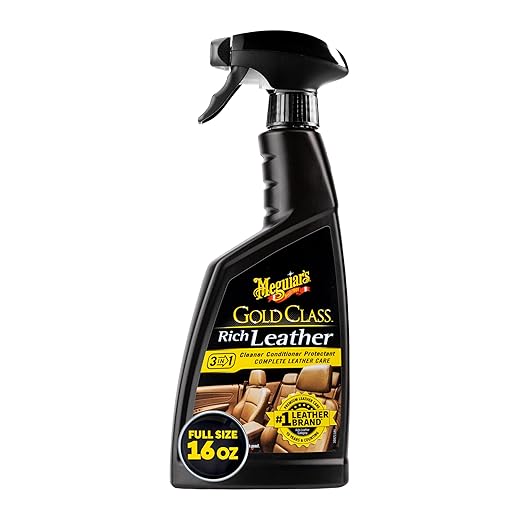
Meguiar's Gold Class 3-in-1 Leather Cleaner and Conditioner Spray
Cleans, conditions, protects with UV defense
A convenient 3-in-1 spray that cleans dirt, conditions leather with nourishing agents and aloe, and provides UV protection to prevent drying and fading. Non-greasy formula leaves no white residue and helps keep car leather soft and supple.
Wipe top-to-bottom with a barely damp microfiber; avoid soaking.
Dry with a clean cloth; condition if leather looks dry.
Ink marks
For smooth leather only: dab (don’t rub) with a cotton swab lightly moistened in isopropyl alcohol; work from edge inward.
If ink lifts, stop and clean with mild soap to neutralize alcohol.
Deep or saturated ink = professional cleaner.
Water stains & rings
Lightly wet entire panel with a damp cloth to even out moisture (prevents rings).
Blot excess, let air-dry away from heat/sun.
Once dry, condition to restore oils.
Salt/snow residue
Brush off crusted salt.
Wipe with 50/50 water + white vinegar on a cloth (test first).
Rinse lightly with a damp cloth, dry, then condition.
Oil & grease spots
Blot immediately with paper/tissue—don’t rub.
Cover with cornstarch or talc; leave overnight to absorb.
Brush off and treat remaining stain with leather cleaner; avoid water first.
Scuffs
Smooth leather: rub with a small amount of neutral shoe cream or conditioner; buff with a soft cloth.
Suede: lift nap with a suede brush or eraser; finish by brushing.
Emergency on-the-go fixes
Alcohol‑free baby wipe for quick surface grime.
Tissue/powder to blot oil until you can treat properly.
Small suede brush or pencil eraser in a travel kit prevents permanent flattening.
Do’s and don’ts
Do patch-test, blot not rub, and work gently from edges to center.
Don’t soak leather, use household bleach, or aggressive scrubbing sponges (e.g., magic erasers can remove finish).
Stop and consult a pro if color lifts, finish peels, or stains are deep.
4
Conditioning, Polishing, and Protecting: Keep Leather Supple and Water-Resistant
You’ve cleaned the dirt away—now restore the leather’s oils, finish, and weather resistance without turning your bag or shoes into a greasy mess. Think of conditioning as feeding, polishing as dressing, and protecting as weatherproofing.
When to condition (by leather type)
Smooth, full-grain leather: after cleaning or every 3–6 months; more often for daily shoes (every 4–8 weeks).
Corrected-grain/coated leather: sparingly—use light creams or sprays; heavy oils can darken or flake finishes.
Suede & nubuck: avoid creams; use nubuck sprays and rejuvenating brushes.
Exotic or patent finishes: check maker guidance—many need specialized products.
Choosing a conditioner or balm
Pick an absorbable, pH‑balanced product—not petroleum-heavy greases for high-end leather. Reliable choices:
Saphir Renovateur (vinyl-safe, nourishing)
Leather Honey (deep conditioning for thick hides)
Bickmore Bick 4 (light, non-darkening)
Sno-Seal or neatsfoot oil only for rugged boots (test first)
Best for Sneakers
Crep Protect Nano Waterproof Shoe Protector Spray
Repels water, oil, and stains
A nano-coating spray that creates an invisible hydrophobic barrier to repel water, oil, and stains on sneakers, leather, suede, nubuck, and canvas. Quick-dry formula lasts several weeks—apply two coats for best protection.
Work on a clean, dry surface. Use a small amount—pea-sized or a dime on a cloth.
Apply in thin, circular motions with a lint‑free cloth or applicator brush.
Allow 10–20 minutes to absorb; wipe excess and buff lightly.Tip: Less is better. Multiple light applications beat one heavy one.
Polishing & buffing techniques
For mirror shine: use cream polish to even color, then wax polish in thin layers. Let each dry briefly, then briskly buff with a horsehair brush and a soft cotton cloth.
For quick touch-ups: colored shoe cream refreshes scuffs without heavy wax.
Use small, controlled strokes on toes and heels; don’t overwork seams.
Protecting from moisture: waxes, sprays, creams
Sprays (e.g., fluoropolymer or silicone-based) give breathability and quick water beading.
Wax creams (Sno‑Seal, bee’s wax blends) add stronger water resistance but reduce breathability—best for work boots.
Creams condition while adding light protection.Remember: no treatment makes leather 100% waterproof; breathability vs. full waterproofing is a trade-off.
Frequency, over-conditioning & hardware care
Signs you’ve over-conditioned: sticky/greasy surface, darkening, clogged pores, or a “soggy” feel. If that happens, wipe with a dry cloth and air out.
Maintain hardware and stitching:
Mask metal parts with tape before applying creams.
Avoid saturating seams—use a brush to work product into edges.
Wipe zips and buckles clean; a tiny dab of beeswax keeps zippers smooth without harming leather.
5
Storage, Travel Care, and Simple Repairs to Extend Life
Short-term care at home and smart travel habits keep leather from deforming or developing long-term damage. Below are compact, practical steps you can use right away.
Smart storage: keep shape, color, and breathability
Stuff bags and shoes lightly with acid‑free tissue or a shoe tree (cedar shoe trees like Woodlore help absorb moisture and odors).
Use cotton dust bags or breathable shoe boxes; avoid sealed plastic which traps humidity and encourages mold.
Control humidity: keep leather in a cool, dry place (45–60% RH). Small silica gel or Boveda humidity packs work well in closets.
For long-term storage, remove detachable straps, open zippers, and don’t hang delicate bags by thin straps to prevent stretching.
If you’ve ever opened a suitcase to find a floppy tote or an odd crease, a few sheets of tissue and a cedar block can save the shape and the embarrassment.
Travel kit: what to pack and quick fixes
Carry a tiny emergency kit for in‑transit touchups:
Small horsehair brush or suede brush
Microfiber cloth
Travel-sized conditioner/cream (10–30 ml)
Tube of neutral or matching color cream
A multi‑tool or small screwdriver for loose hardware
Professional Choice
All-Purpose Leather and Vinyl Repair Kit
Color-mixable formula for professional results
An easy-to-use repair kit with 10 mixable colors and clear instructions to fix scratches, cuts, cracks, and pet damage on leather, vinyl, and faux materials. Fast-drying compounds deliver near-professional restoration and include customer support and satisfaction guarantee.
Packing tips: place shoes in separate bags, shoe toes toward the center of a suitcase with bags tucked around them, and keep delicate bags on top. For immediate scuffs, wipe gently, apply a dab of cream with a cotton swab, then buff.
DIY repairs you can try safely
Reattaching loose hardware: tighten rivets or screws with a small screwdriver; for popped studs, press leather glue (Barge cement) into place and clamp briefly.
Minor sole wear: for small heels or separated edges, use Shoe Goo or Barge for a temporary fix; major wear needs resoling.
Touching up scuffs: clean, apply color cream lightly with a cotton swab, warm with a hairdryer on low, then buff to blend.
When stitching comes loose, a saddle‑stitched repair with waxed thread is doable if you’re handy; otherwise, take it to a cobbler.
Troubleshooting common long‑term problems
Drying: regular light conditioning prevents brittleness; deep cracks may require professional restoration.
Cracking: small surface cracks can improve with repeated conditioning; structural cracks need expert attention.
Persistent stains/mold: brush off mold outdoors, then wipe with a 1:1 water‑white vinegar solution and dry thoroughly; stubborn stains should go to a leather specialist.
With storage, travel prep, and a few home repairs you’ll keep leather looking intentional rather than neglected — next, we’ll pull these habits together in the article’s final simple steps for lasting style.
Simple Steps for Lasting Style
Quick, regular care—daily wipes, proper storage, and monthly conditioning—keeps leather bags and shoes looking sharp and extends their life. Learn your leather type, use gentle products, and address stains promptly to avoid permanent damage.
Reserve professional repair for deep scratches, structural damage, or complex restorations. Start with simple daily habits today, schedule a monthly maintenance check, and your leather pieces will reward you with lasting style, comfort, and confidence every season for many years ahead, reliably.
20 responses to “Keep It Stylish: Quick Leather Care for Bags & Shoes”
Maya Patel
Great article — finally something that treats leather care like a five-minute habit instead of a weekend ritual. Loved the daily/weekly routine section. A couple thoughts/questions:
– I use Leather Honey for my commuter bag and it keeps the leather soft, but does anyone worry about it darkening lighter leathers?
– The adjustable shoe trees seem like a game-changer for travel, but how do they fit sneakers vs dress shoes?
Also, tiny nitpick: the cleaning steps were super clear, but I’d love a short checklist graphic for travel (spray, brush, stuff). Overall very practical 👍
Ethan Brooks
Agree on spot-testing. I used Leather Honey on a tan wallet once and it got a bit richer in color. Not a dealbreaker, but good to know. For sneakers I just jam a rolled-up sock in there when flying — lazy but works 😂
Nora Lane
For anyone worried about darkening: dilute the conditioner slightly (mix a tiny amount with water) and do a very light first pass. Won’t hurt, and you can always add another light coat later.
Thanks Maya — really appreciate the feedback! Leather Honey can darken some lighter leathers slightly; I recommend spot-testing on an inside seam first. For shoe trees: the adjustable ones work best for dress shoes; for bulky sneakers you might prefer plastic forms or stuffing with tissue paper for travel. A travel checklist is a great idea — noted for a future update.
Sophie Nguyen
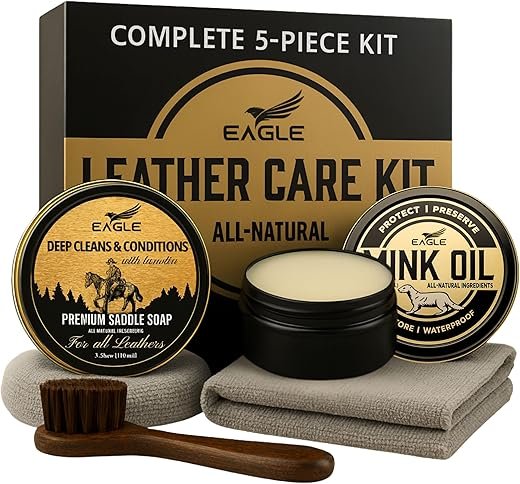
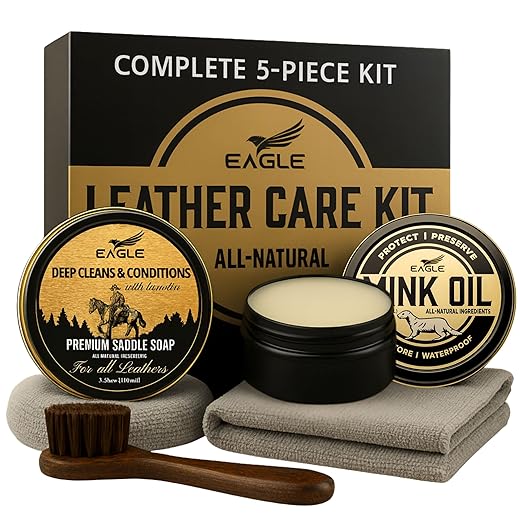
Quick question — the article mentioned mink oil in the Complete Leather Boot Care Kit and Leather Honey as separate options. Which one is better for vintage leather handbags? I’m worried about clogging pores vs keeping them soft. Any experience?
Good question. For vintage handbags I usually recommend Leather Honey (or another lanolin-based conditioner) over mink oil. Leather Honey conditions deeply but is less likely to overly darken or clog the leather pores long-term. Always spot-test and use sparingly; vintage pieces often benefit from lighter treatments more frequently.
Maya Patel
Agreed — go lighter and more often. I used mink oil on an old satchel once and it deepened the color too much for my taste. Leather Honey gave softer results without that heavy “oiled” look.
Liam Carter
I tried the Complete Leather Boot Care Kit last winter and it saved my boots after trudging through slush for months. Quick notes:
– Mink oil made them water-resistant fast, but it did darken the leather noticeably. If you like the patina, perfect; if not, test first.
– Meguiar’s spray is AMAZING for quick midweek touch-ups on the car seats and a leather jacket — two sprays, wipe, done.
– The All-Purpose Repair Kit actually fixed a tiny scuff on my office chair; shocking but true.
A couple of questions for folks who’ve used multiple products: which do you reach for when you need something fast and light vs deep conditioning? I’m trying to decide between keeping both Leather Honey and Meguiar’s in my kit or rotating seasonally. typos: prob spelled Meguiar wrong? lol
Harold Finch
Haha you spelled it right — most people butcher Meguiar’s. Quick tip: if you’re worried about darkening, use the repair kit plus a small dab of conditioner to blend, then buff gently. Works for small patches.
Thanks for the share, Liam — super helpful real-world notes. For fast/light: Meguiar’s Gold Class spray is ideal (cleaner + conditioner in one) — good for quick touch-ups on jackets or seats. For deep conditioning, Leather Honey is longer-lasting and better for dried-out boots/bags. Keeping both is a solid approach: spray for weekly maintenance, Leather Honey for quarterly deep care.
Sophie Nguyen
I rotate seasonally like you said. Meguiar’s all spring/summer, Leather Honey in fall/winter when things get dry. Mink oil only for heavy-duty boots — not my go-to for nice dress shoes.
Ava Morales
I keep both too. Meguiar’s for speed and Leather Honey for keeping a bag supple. Also the boot kit + mink oil saved my hiking boots after a muddy trip last year — soaked it in and they came back to life.
Daniel Price
Minor PSA: don’t mix oils/conditioners without testing. I once layered mink oil over a silicone-based protector and got weird tackiness.
One more quick note: Crep Protect is great on fabric sneakers but can make some smooth leathers slightly dull — test first.
Carlos Ramirez
Solid guide. The storage and travel care tips were the most useful for me — I’d been stuffing shoes into backpack pockets and wondering why they warped. A couple longish notes:
I bought the Adjustable Men’s Shoe Trees Five-Pair Pack after reading a similar post last year and they’re a game-changer. For anyone who travels a lot: pack them in checked luggage or buy a cheap pair to leave at the hotel — that way you’re not lugging heavy wood on every flight.
Also: small tip on the Crep Protect Nano spray — reapply after heavy rain even if it says long-lasting. I learned the hard way, my suede slipped when I assumed it was invincible 😅
One more thing: are there any must-have multi-tools for simple repairs from the All-Purpose Leather and Vinyl Repair Kit? I’d like a tiny kit for on-the-go fixes.
Rachel Kim
Agree on reapplying the waterproof spray. Also FYI: some sprays can change suede texture a bit — brush after drying to restore nap.
Great points, Carlos. For travel I recommend lightweight plastic shoe trees or stuffing with paper for sneakers. Regarding repair tools: a small palette knife, fine-grit sandpaper, and a tiny jar of colorant (from the repair kit) cover most on-the-go fixes. A small glue tube can help reattach loose trim.
Tom Briggs
If budget’s tight: use newspaper to stuff shoes in a pinch. Not as good as shoe trees but beats a flattened toe.
Liam Carter
I carry a tiny Swiss Army knife (legal in checked bags) plus a small repair kit pouch. The palette knife idea is gold — screed the filler evenly and it looks way better than dabbing with a finger.
Tom Briggs
Nice read. Short version: if you own leather, buy shoe trees and Crep Protect. Done. Also, mink oil smells like a campfire from my grandpa’s garage — blame nostalgia or whatever. 😆





20 responses to “Keep It Stylish: Quick Leather Care for Bags & Shoes”
Great article — finally something that treats leather care like a five-minute habit instead of a weekend ritual. Loved the daily/weekly routine section. A couple thoughts/questions:
– I use Leather Honey for my commuter bag and it keeps the leather soft, but does anyone worry about it darkening lighter leathers?
– The adjustable shoe trees seem like a game-changer for travel, but how do they fit sneakers vs dress shoes?
Also, tiny nitpick: the cleaning steps were super clear, but I’d love a short checklist graphic for travel (spray, brush, stuff). Overall very practical 👍
Agree on spot-testing. I used Leather Honey on a tan wallet once and it got a bit richer in color. Not a dealbreaker, but good to know. For sneakers I just jam a rolled-up sock in there when flying — lazy but works 😂
For anyone worried about darkening: dilute the conditioner slightly (mix a tiny amount with water) and do a very light first pass. Won’t hurt, and you can always add another light coat later.
Thanks Maya — really appreciate the feedback! Leather Honey can darken some lighter leathers slightly; I recommend spot-testing on an inside seam first. For shoe trees: the adjustable ones work best for dress shoes; for bulky sneakers you might prefer plastic forms or stuffing with tissue paper for travel. A travel checklist is a great idea — noted for a future update.
Quick question — the article mentioned mink oil in the Complete Leather Boot Care Kit and Leather Honey as separate options. Which one is better for vintage leather handbags? I’m worried about clogging pores vs keeping them soft. Any experience?
Good question. For vintage handbags I usually recommend Leather Honey (or another lanolin-based conditioner) over mink oil. Leather Honey conditions deeply but is less likely to overly darken or clog the leather pores long-term. Always spot-test and use sparingly; vintage pieces often benefit from lighter treatments more frequently.
Agreed — go lighter and more often. I used mink oil on an old satchel once and it deepened the color too much for my taste. Leather Honey gave softer results without that heavy “oiled” look.
I tried the Complete Leather Boot Care Kit last winter and it saved my boots after trudging through slush for months. Quick notes:
– Mink oil made them water-resistant fast, but it did darken the leather noticeably. If you like the patina, perfect; if not, test first.
– Meguiar’s spray is AMAZING for quick midweek touch-ups on the car seats and a leather jacket — two sprays, wipe, done.
– The All-Purpose Repair Kit actually fixed a tiny scuff on my office chair; shocking but true.
A couple of questions for folks who’ve used multiple products: which do you reach for when you need something fast and light vs deep conditioning? I’m trying to decide between keeping both Leather Honey and Meguiar’s in my kit or rotating seasonally. typos: prob spelled Meguiar wrong? lol
Haha you spelled it right — most people butcher Meguiar’s. Quick tip: if you’re worried about darkening, use the repair kit plus a small dab of conditioner to blend, then buff gently. Works for small patches.
Thanks for the share, Liam — super helpful real-world notes. For fast/light: Meguiar’s Gold Class spray is ideal (cleaner + conditioner in one) — good for quick touch-ups on jackets or seats. For deep conditioning, Leather Honey is longer-lasting and better for dried-out boots/bags. Keeping both is a solid approach: spray for weekly maintenance, Leather Honey for quarterly deep care.
I rotate seasonally like you said. Meguiar’s all spring/summer, Leather Honey in fall/winter when things get dry. Mink oil only for heavy-duty boots — not my go-to for nice dress shoes.
I keep both too. Meguiar’s for speed and Leather Honey for keeping a bag supple. Also the boot kit + mink oil saved my hiking boots after a muddy trip last year — soaked it in and they came back to life.
Minor PSA: don’t mix oils/conditioners without testing. I once layered mink oil over a silicone-based protector and got weird tackiness.
One more quick note: Crep Protect is great on fabric sneakers but can make some smooth leathers slightly dull — test first.
Solid guide. The storage and travel care tips were the most useful for me — I’d been stuffing shoes into backpack pockets and wondering why they warped. A couple longish notes:
I bought the Adjustable Men’s Shoe Trees Five-Pair Pack after reading a similar post last year and they’re a game-changer. For anyone who travels a lot: pack them in checked luggage or buy a cheap pair to leave at the hotel — that way you’re not lugging heavy wood on every flight.
Also: small tip on the Crep Protect Nano spray — reapply after heavy rain even if it says long-lasting. I learned the hard way, my suede slipped when I assumed it was invincible 😅
One more thing: are there any must-have multi-tools for simple repairs from the All-Purpose Leather and Vinyl Repair Kit? I’d like a tiny kit for on-the-go fixes.
Agree on reapplying the waterproof spray. Also FYI: some sprays can change suede texture a bit — brush after drying to restore nap.
Great points, Carlos. For travel I recommend lightweight plastic shoe trees or stuffing with paper for sneakers. Regarding repair tools: a small palette knife, fine-grit sandpaper, and a tiny jar of colorant (from the repair kit) cover most on-the-go fixes. A small glue tube can help reattach loose trim.
If budget’s tight: use newspaper to stuff shoes in a pinch. Not as good as shoe trees but beats a flattened toe.
I carry a tiny Swiss Army knife (legal in checked bags) plus a small repair kit pouch. The palette knife idea is gold — screed the filler evenly and it looks way better than dabbing with a finger.
Nice read. Short version: if you own leather, buy shoe trees and Crep Protect. Done. Also, mink oil smells like a campfire from my grandpa’s garage — blame nostalgia or whatever. 😆